
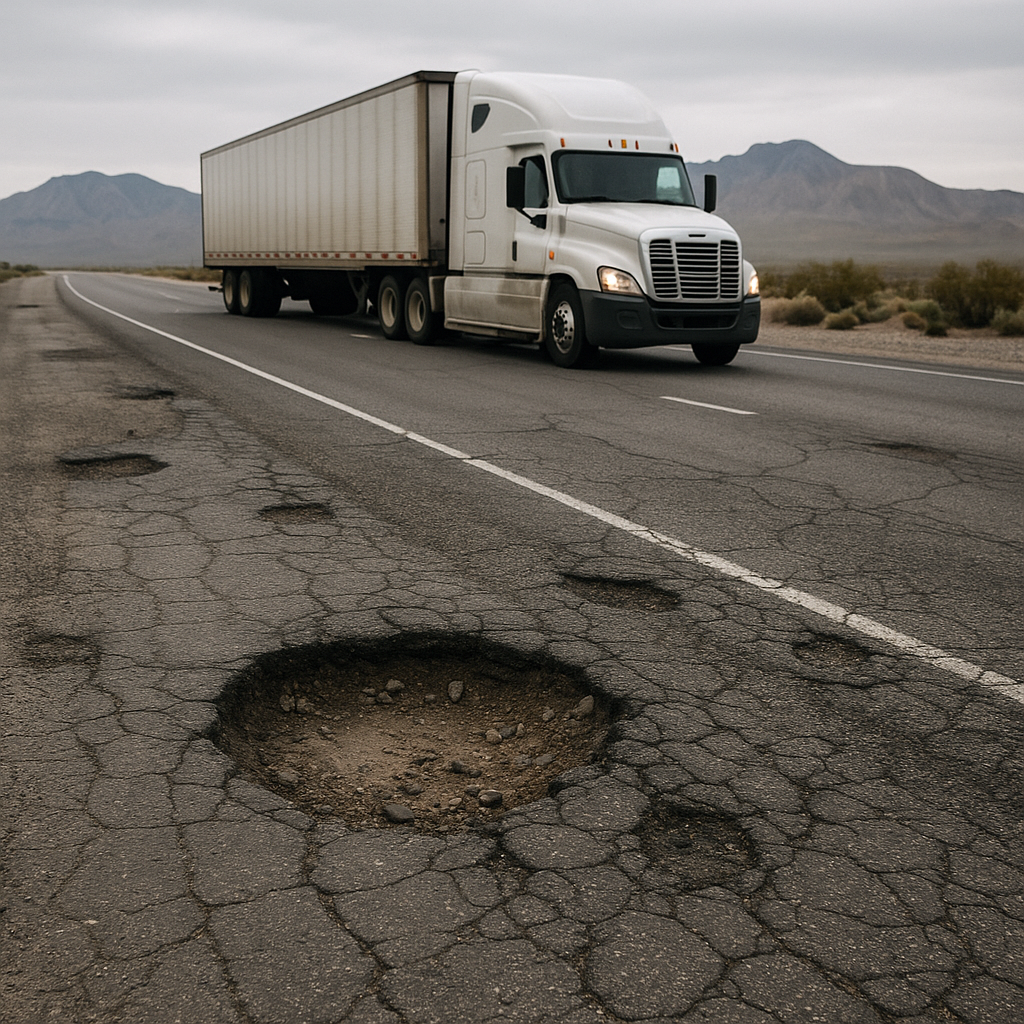
How Potholes Affect Truck Accident Risk in Nevada
When you think of Nevada’s many highways and byways — from the urban arteries of Las Vegas and Reno to the long desert stretches of I-80 — you might picture wide open roads and scenic views. But beneath the wheels of countless cars and trucks, a less romantic reality lurks: potholes. In Nevada, potholes aren’t just a maintenance issue; they’re a real safety risk, especially for the large commercial trucks that crisscross the state delivering goods. In this article, we’ll explore how potholes affect truck accident risk in Nevada, why trucks are uniquely vulnerable, and how local weather patterns contribute to the problem.
Overview of Nevada’s Road Conditions and Weather
Nevada is a land of climatic extremes. Most of the state is dominated by desert landscapes, high mountain ranges, and sizable temperature swings between day and night. In addition to the arid climate in Southern Nevada around Las Vegas, the northern regions near Reno and Elko experience colder winters, occasional snow, and frequent freeze-thaw cycles.
These freeze-thaw cycles are particularly notorious for wreaking havoc on the state’s roadways. When water seeps into small cracks in the pavement, it freezes at night (expanding within the road surface) and then melts during the day. This constant expansion and contraction weakens the pavement structure, eventually causing sections to break apart and form potholes.
Beyond just temperature, Nevada has significant population centers and interstate traffic—Las Vegas ranked among the fastest-growing cities in the country. The surge in vehicles, including heavy trucks, places more stress on infrastructure already taxed by environmental conditions. The result is a constant battle to fill, patch, and repave the state’s roadways, particularly on key trucking routes such as I-15, I-80, and US 395.
How Potholes Affect Trucks Differently Than Cars
While potholes are a nuisance to all drivers, their impact is dramatically greater for trucks—especially the heavy tractor-trailers that make up a significant portion of Nevada’s commercial traffic.
1. Vehicle Weight and Load:
Trucks, especially fully-laden semi-trailers, can weigh up to 80,000 pounds, while the average car tips the scales at around 3,000–4,000 pounds. A pothole that gives a car a jolt can destabilize a truck, especially if the load shifts suddenly.
2. Suspension and Wheel Size:
Trucks have larger, more complex suspension systems, but they’re uniquely vulnerable to pothole damage. A deep pothole can cause tire blowouts or bent axles in trucks, with far more severe consequences than for lighter vehicles.
3. Stopping Distance:
It already takes a fully-loaded semi much longer to come to a complete stop than a car. If a driver swerves to avoid a pothole or loses control after hitting one, the chance of stopping in time to prevent a collision is greatly reduced.
4. Cargo Shifting:
Cargo can shift dramatically if a truck’s tires drop into a deep pothole. Sudden shifts can cause a load to become unbalanced, increasing the risk of tipovers, jackknifing, or the loss of cargo onto the roadway.
5. Lane Deviation:
Trucks are long and wide, and hitting a pothole can cause the entire vehicle to lurch into an adjacent lane or onto the shoulder. A truck that veers unexpectedly creates serious risks for nearby motorists.
Why Crashes Can Become Severe Under These Conditions
On Nevada highways, any collision involving a big rig has the potential to cause significant damage or injury. When potholes factor in, the risks can multiply exponentially due to the following reasons:
1. Loss of Control:
Hitting a pothole at highway speed can destabilize a truck, especially if one side of the vehicle drops into a depression. Momentary loss of steering control can send the truck veering into other lanes, off the road, or even into oncoming traffic.
2. Rollover Risk:
If the truck is carrying a top-heavy load, a deep pothole can cause a sudden tilt or lurch. Combined with a shift in the load, this can result in a rollover accident—an especially harrowing prospect on the interstate.
3. Multi-Vehicle Incidents:
A swerving or out-of-control truck can be a catastrophe for vehicles in its vicinity. Even if the truck itself remains upright, a sudden evasive maneuver can cause chain-reaction crashes involving several vehicles.
4. Road Debris:
Severe potholes can damage trucks badly enough to send tire fragments, bent wheels, or even pieces of cargo onto the road, creating new hazards for others.
5. Delayed Emergency Response:
Many of Nevada’s highways, especially rural ones, are miles from the nearest EMS provider. Severe crashes caused by truck instability from potholes can have delayed response times, with increased health risks for those involved.
Common Seasonal Patterns in Nevada
Nevada’s patterns of pothole formation and repair are closely tied to its seasons. In northern Nevada, snowmelt and freeze-thaw cycles peak in late winter and early spring. These months see some of the worst pothole outbreaks, especially on major trucking routes like I-80 and the roads around Reno and Carson City.
Meanwhile, in southern Nevada, where rainfall is rarer but monsoon storms can be intense, potholes can form in a matter of hours after heavy rain. During the summer, the intense heat softens asphalt, making it more susceptible to damage from the weight and friction of passing trucks. When the occasional rainstorm arrives, it can easily penetrate already-weakened pavement, especially in high-traffic areas such as Las Vegas Boulevard or the Spaghetti Bowl interchange.
Nevada’s Department of Transportation (NDOT) and local agencies work year-round to address potholes, but resources are inevitably stretched thin, especially after winter storms or rainy periods. Truck drivers and fleet managers are advised to stay up-to-date with NDOT’s live road reports and adjust routes if stretches are known to be in poor repair.
Conclusion
Nevada’s road conditions are shaped by its unique geography and weather patterns. Potholes are a persistent hazard that all drivers face, but the risks associated with truck accidents can be especially severe due to the size, weight, and cargo of commercial vehicles. Understanding how potholes affect truck accident risk in Nevada can help drivers remain vigilant and encourage ongoing investment in road maintenance. While not every pothole can be eliminated, awareness, timely reporting, and preventive measures can go a long way to keeping Nevada’s roads safer for everyone.