
Construction Material Trucking Routes in Nevada: An In-Depth Guide
Overview of the Freight Corridor or Trucking Activity
Nevada’s rapidly expanding urban centers, robust mining industry, and significant infrastructure projects all depend on an intricate network of trucking routes. Construction material transport plays a vital role in supporting growth within cities like Las Vegas, Reno, and the mining towns of Northern Nevada. These construction material trucking routes in Nevada span busy interstate highways, remote rural roads, and specialized industrial corridors, each presenting unique opportunities and challenges for freight movement.
The Silver State’s vast geography, characterized by mountain passes, desert valleys, and urban sprawl, necessitates strategic routing for construction material loads. Major arteries such as Interstate 15, Interstate 80, and U.S. Highway 95 serve as key conduits between quarries, distribution hubs, and construction sites. Additionally, state highways and county roads provide access to remote areas, especially in the context of mining operations and renewable energy installations.
The dynamic nature of Nevada’s construction sector—fuelled by new casino developments, residential expansion, and public works—means a steady and significant flow of materials like aggregate, cement, lumber, rebar, steel, and pipe. With development booming in both the Las Vegas Valley and the Reno-Tahoe region, the logistics that underpin timely delivery of these materials are crucial to meeting demanding project timelines.
Common Truck Types and Freight Activity in the Area
Nevada’s construction material trucking landscape is defined by a variety of truck types designed to handle different kinds of loads. Some of the most common vehicles seen on Nevada roads include:
1. End-Dump Trucks:
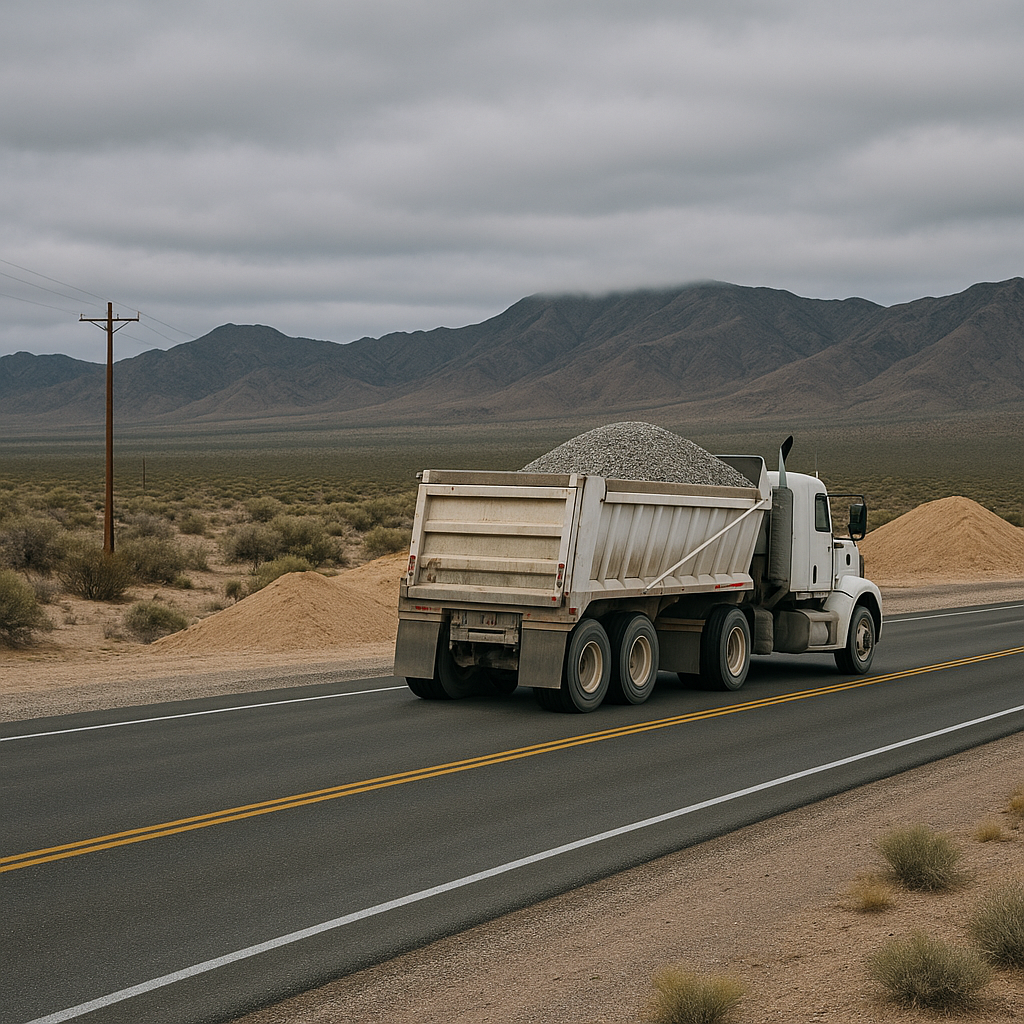
Used widely for hauling bulk materials such as sand, gravel, aggregate, and earth, end-dump trucks are fixtures on both interstates and rural roads. Their ability to swiftly unload materials makes them a staple for both roadwork and site preparation.
2. Flatbed Trucks:
Essential for transporting rebar, steel beams, lumber, precast concrete, and oversized loads, flatbed trucks are frequently spotted heading to and from manufacturing facilities, distribution centers, and project sites across the state.
3. Cement Mixers (Ready-Mix Trucks):
With burgeoning real estate and infrastructure spending, cement mixers are a constant presence on Nevada’s roads. These trucks ferry ready-mix concrete from batch plants to construction sites—especially in the urban centers of Las Vegas and Reno.
4. Lowboy and Heavy Haul Trailers:
For moving oversized equipment (such as excavators, cranes, and prefabricated modules) to construction and mining destinations, specialty lowboy and heavy-haul trailers are indispensable. These often require special permits for travel.
5. Pneumatic Tankers:
Used for transporting bulk materials like powdered cement or fly ash, pneumatic tankers ensure a steady supply chain for large-scale construction projects and manufacturing.
The freight activity associated with construction material transport is diverse and operates on both macro and micro scales. Large-scale highways carry long-distance deliveries between aggregate quarries in northern Nevada and major projects as far south as Las Vegas. Meanwhile, local hauls distribute materials from staging yards to project points within city limits or suburbs. In mining regions—especially in Elko, Humboldt, White Pine, and Nye counties—truck traffic often increases in response to new pit developments, mill upgrades, and infrastructure expansion.
Construction material trucking in Nevada is highly season-dependent (see below) and is also influenced by major public works, such as the multi-billion-dollar I-15/Tropicana Interchange in Las Vegas, and ongoing roadway maintenance that keeps state highways accessible year-round.
How Congestion or Merging Creates Risk
Nevada’s roadways—especially in and around major city centers—are susceptible to traffic congestion, which can significantly impact construction material trucking routes. Nowhere is this more true than in Las Vegas during peak commute hours, when the convergence of personal vehicles, delivery vans, and heavy trucks produces bottlenecks on the I-15, I-215 Beltway, and U.S. 95 corridors.
Freight trucks, especially those carrying heavy or unstable loads such as aggregates and precast concrete, have longer stopping distances, wider turning radii, and require more space to merge safely. When congestion builds up around highway interchanges or in urban zones, trucks must often make split-second decisions to change lanes, merge, or exit—each action heightening the risk of incidents. For example, construction activity near Spaghetti Bowl in Reno and Centennial Bowl in Las Vegas intensifies merging complexity, as construction zones frequently alter lane patterns with little notice.
Moreover, rural highways linking remote construction or mining sites may present their own challenges. Two-lane roads on mountainous routes, like State Route 80 toward Elko or U.S. 93 near the Ely region, require careful overtaking and limited opportunities for safe passing. Inclement weather such as sudden dust storms, high winds, or black ice can further complicate truck operations on these stretches.
The risk nexus is highest where local passenger vehicles are less familiar with slow-moving or oversized truck behavior—such as in fast-developing suburban zones around Henderson, Summerlin, Spanish Springs, or Fernley. Managed pain points, including well-signed lanes, clear merging points, and up-to-date route information, are critical in mitigating incidents involving construction material trucks on Nevada’s most active freight routes.
Time-of-Day and Seasonal Traffic Trends
In Nevada, both time of day and seasonality play pivotal roles in defining traffic patterns for construction material trucking. These fluctuations are largely shaped by climate, local industry demands, and regional commuting habits.
Time-of-Day Trends
Trucking activity mapping reveals distinct peaks that coincide with the broader construction sector’s hours and regional commuting surges. The greatest volume of construction material trucking tends to occur in early to mid-mornings (5:00 AM to 10:00 AM), as deliveries of aggregate, concrete, and structural materials are timed to begin work at sunrise and avoid midday heat, especially in the southern part of the state.
Late afternoons (2:00 PM to 5:00 PM) see a secondary surge as trucks return from job sites or prepare for overnight deliveries on intercity routes. The overlap between outbound truck traffic and urban commuter flow (particularly Fridays in Las Vegas and Reno) can lead to notable slowdowns and increased risk at high-volume interchanges.
Overnight hauls—though less common for short local deliveries—are utilized for oversized or heavy loads that require clear roads for safe passage, or when off-peak delivery windows are mandated by municipal ordinances to minimize daytime disruption.
Seasonal Fluctuations
Nevada’s harsh desert climate and mountainous winters greatly influence the construction calendar, and in turn, truck traffic. Construction activity diminishes in high-elevation and northern regions during the late fall and winter months, as snow, ice, or freeze-thaw cycles limit site work. The Sierra crest and Great Basin valleys experience the most pronounced slowdown in trucking for construction materials from December through February, with reduced demand for aggregate and concrete due to weather constraints.
Conversely, the spring thaw through early autumn (March through October) constitutes peak season for construction material movement statewide. Southern Nevada, with its milder winters, supports more year-round trucking; nevertheless, extreme summer heat may shift heavy delivery activity to overnight and early-morning hours in cities like Las Vegas or Henderson to protect materials and workers alike.
Holiday periods, regional events (such as the National Finals Rodeo in Las Vegas or Burning Man in Black Rock Desert), and major conventions also temporarily alter freight flows. These events can add congestion or traffic restrictions on key construction material trucking routes in Nevada, prompting shift adjustments or alternate routing for trucks.
Navigating Nevada’s Construction Material Trucking Landscape
Nevada’s thriving construction sector relies on a resilient, adaptable network of trucking routes that span urban interstates, rural highways, and all points in between. From Las Vegas’s expanding cityscape to the high deserts of the north, efficient and safe delivery of materials is pivotal for continued growth and infrastructure modernization. Amidst the state’s unique geographical, climatic, and economic factors, understanding the nuances of construction material trucking routes in Nevada is vital for both logistics professionals and the broader public. Staying informed about traffic trends, route challenges, and the diversity of trucks on the roads helps foster a safer, more reliable flow of materials that supports Nevada’s future.