
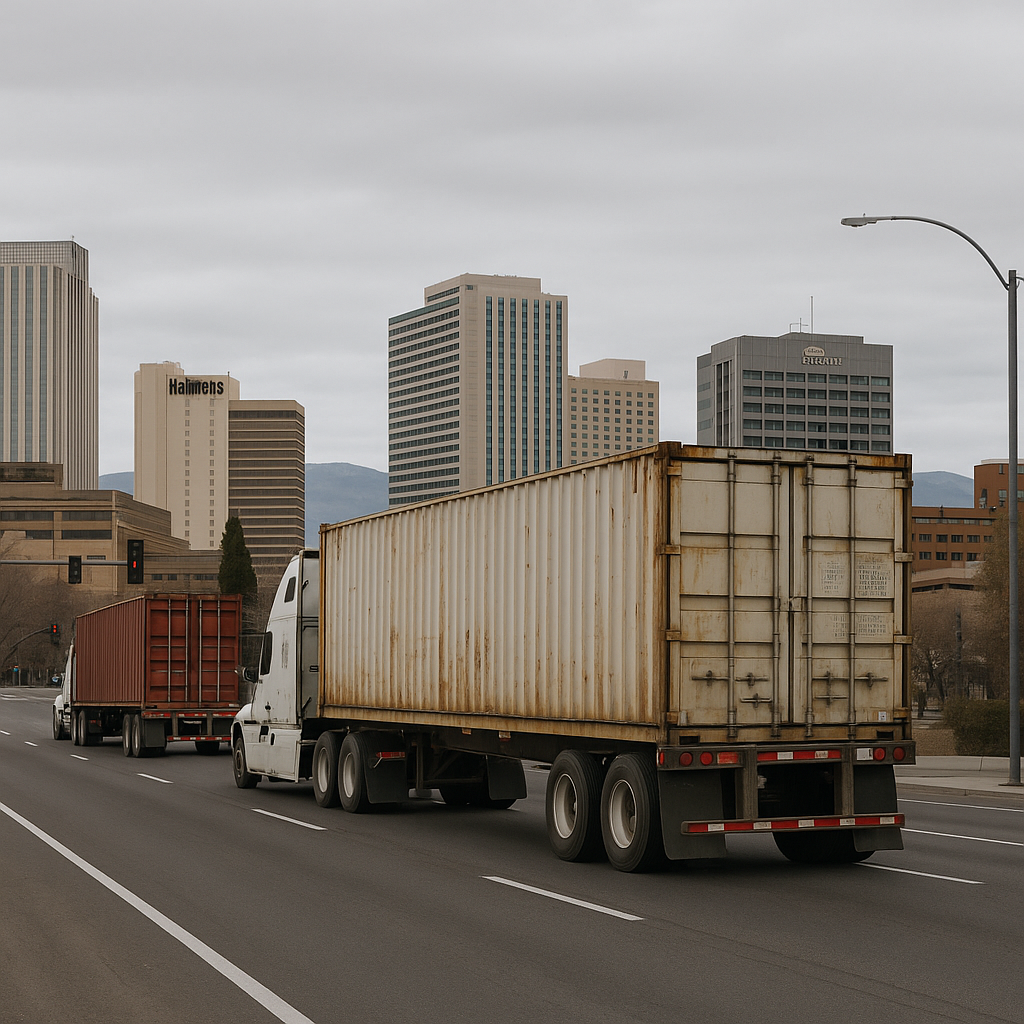
Understanding Truck Traffic Patterns Around Downtown Reno
Downtown Reno, Nevada, serves as a vibrant hub for commerce, tourism, and transportation. Its strategic location at the crossroads of major highways and its proximity to Northern Nevada’s industrial corridors make it a vital point for freight movement. As the “Biggest Little City in the World” continues to grow, understanding truck traffic patterns around downtown Reno becomes increasingly important for city planners, businesses, and residents alike. This article explores how trucking activity is structured in this area, the types of trucks and freight commonly seen, risk factors caused by congestion, and when traffic peaks due to time-of-day or seasonal trends.
Overview of Freight Corridors and Trucking Activity
Reno sits at a critical geographic intersection, making it a natural conduit for freight haulage. Interstate 80 (I-80), running east-west, and U.S. Highway 395 (also known as I-580 in some stretches), running north-south, form the backbone of Reno’s transport infrastructure. These highways channel significant volumes of freight, serving as gateways between California, the Pacific Northwest, and the Midwest.
Downtown Reno lies just south of the I-80 corridor and is bounded by arterial roads such as North Virginia Street, South Wells Avenue, and East 2nd Street. Many regional warehouses, distribution centers, and industrial operations are situated nearby, particularly in the Reno-Sparks and Tahoe-Reno Industrial Center areas. Trucks frequently enter downtown Reno to make deliveries to hotels, casinos, restaurants, and retail centers, or to reroute towards local businesses and residential construction projects.
Nevada’s logistics ecosystem has seen robust growth in recent years, with e-commerce, manufacturing, and warehousing thriving due to the state’s business-friendly environment and proximity to West Coast ports. As such, truck traffic patterns downtown Reno continue to reflect rising freight volumes and complex routing demands.
Common Truck Types and Freight Activity in the Area
Several truck types share Reno’s downtown roads, reflecting the diversity of freight activity in this region.
1. Semi-trailers (18-wheelers)
Most long-haul shipments traversing the I-80 and I-580 corridors use standard semi-trailers. These trucks often transport goods ranging from packaged consumer products to industrial equipment. While the heaviest volumes bypass downtown via interstate exits, a number must navigate city streets to reach local destinations or when construction or congestion on main routes prompts detours.
2. Box trucks and delivery vans
Used for local and regional deliveries, box trucks and Sprinter-style vans frequent downtown corridors. Many supply local businesses with food, beverages, office supplies, or parcel deliveries. In Reno, the presence of hotels, casinos, and entertainment venues generates consistent delivery traffic.
3. Dump trucks and construction vehicles
Ongoing development in downtown Reno—new hotels, apartment complexes, and infrastructure upgrades—means a regular presence of dump trucks hauling gravel, demolition debris, or construction materials.
4. Specialized vehicles
Tanker trucks (for fuel or chemicals), flatbeds (for construction materials or heavy machinery), and refrigerated trucks are also a regular sight. These cater to specific needs across hospitality, construction, and retail.
The destination diversity and overlaps with passenger vehicle patterns can create unique local challenges. Delivery schedules often follow business hours, though refrigerated and perishable goods might require nocturnal deliveries.
How Congestion or Merging Creates Risk
Downtown Reno’s trucking activity is concentrated along specific arterial routes with variable road capacities, creating several risk factors:
– Narrow streets and sharp turns: If semi-trailers must leave the main highways to make local deliveries, navigating the historic, often narrow downtown streets can become challenging. Turning radii, tight intersections, and curbside parking raise the likelihood of minor collisions, especially during busy periods.
– High volumes at key intersections: Points where trucks merge from I-80 or I-580 onto downtown roads—such as through Spaghetti Bowl (the interchange of I-80 and US 395/I-580)—are common sites for bottlenecks. Here, passenger vehicles and commercial trucks must merge, slow, or change lanes in short distances, sometimes resulting in sudden braking or side-swipes.
– Loading zones and curbside deliveries: With limited curbside delivery space, trucks may double-park or obstruct lanes on popular streets like Virginia Street. This reduces clear sightlines and can force other vehicles—including cyclists and buses—into adjacent lanes.
– Pedestrian and cyclist activity: Reno’s revitalized downtown sees significant foot and bike traffic, especially during events or festivals. Large trucks have restricted visibility, and multiple users vying for space can increase collision risk.
Local agencies and the Nevada Department of Transportation (NDOT) monitor these intersections. Improvements such as dedicated loading zones, time-restricted delivery windows, and signal modifications help alleviate risks, but congestion during peak business hours is still a concern.
Time-of-Day and Seasonal Traffic Trends
Understanding truck traffic patterns downtown Reno requires considering both the time of day and the time of year.
Time of Day:
– Morning peaks (6:00–9:00 a.m.): Many local and long-haul deliveries are scheduled early to beat both commuter and midday traffic. Construction vehicles head out for the day, and regular stocking for hotels and restaurants is under way.
– Midday lull (10:00 a.m.–2:00 p.m.): Truck traffic remains steady but less intense, as most delivery schedules are met, and traffic signals flow more freely.
– Afternoon increase (3:00–6:00 p.m.): Freight and passenger vehicles overlap during the end-of-day rush, particularly along main commuter routes and near on-ramps to I-80 and I-580.
– Overnight and early morning (11:00 p.m.–5:00 a.m.): Some large suppliers and construction projects take advantage of reduced vehicle and pedestrian activity, scheduling deliveries overnight to minimize disruption.
Seasonal Variation:
– Winter: Snow and icy road conditions can slow all traffic, including trucks, especially on inclined routes and around the Spaghetti Bowl. NDOT implements chain control and other restrictions when weather is severe.
– Summer: Construction projects ramp up, leading to more construction truck activity and potential road closures or detours. Concurrently, tourism swells, increasing the need for hotel and casino deliveries and making downtown busier.
– Special events: Large festivals, concerts, or sporting events in the downtown area can temporarily reroute trucks, restrict delivery hours, or lead to increased congestion due to street closures.
Conclusion
Truck traffic is an essential element of downtown Reno’s economy and daily logistics. As Nevada’s economic landscape evolves—spurred by growth in warehousing, e-commerce, and hospitality—understanding truck traffic patterns downtown Reno remains crucial for maintaining safe, efficient, and vibrant city life. While truck routes strive to balance the priorities of freight movement and urban vitality, ongoing monitoring and community engagement will help Reno manage its streets for residents, businesses, and visitors alike.