
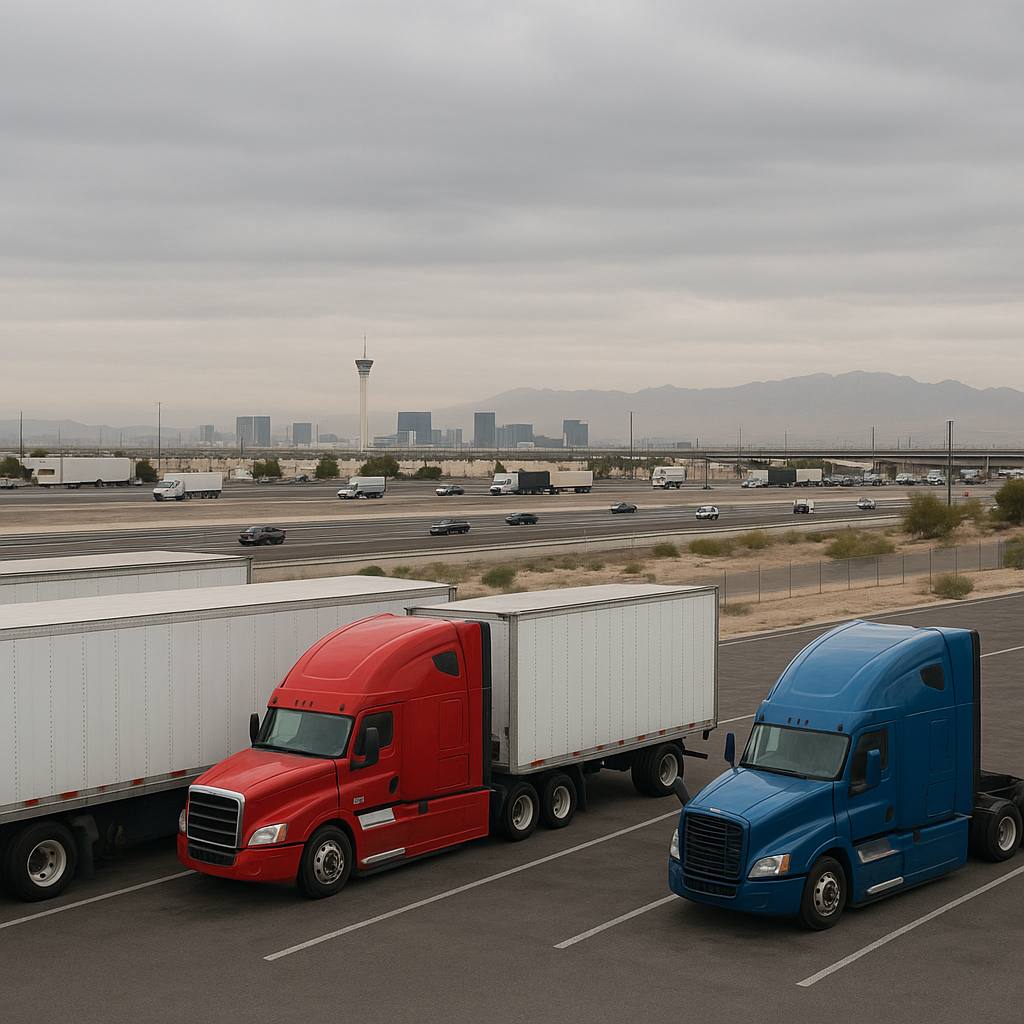
Where Trucks Park Near Las Vegas Freight Routes
Overview of the Freight Corridor or Trucking Activity
Nevada’s position as a logistics hub has grown significantly over the past decade, with Las Vegas at the heart of this regional transformation. Known for its entertainment glamour, Las Vegas is equally vital as a freight gateway linking California, Arizona, and Utah. Interstate 15 (I-15) is the principal freight corridor, acting as a conduit for goods movement between Southern California ports and interior western markets. Other significant routes include US-93, US-95, and the recently upgraded beltways (I-215 and CC-215), all contributing to a freight ecosystem that operates almost non-stop.
The question of where trucks park near Las Vegas freight routes is critical, as parking serves as both a safety requirement and an operational necessity. Parking lots are needed for mandatory rest breaks, staging before urban delivery, maintenance, or simply catching up on paperwork. Along these corridors, official truck stops, rest areas, and industrial yards serve as primary parking zones. However, increased truck activity poses challenges in parking availability and safety.
The city’s proximity to major import/export pathways ensures that trucks hauling everything from electronics to groceries depend consistently on Las Vegas as a strategic stop. Drivers often plan stops around available truck parking on approaches to major urban interchanges, especially before entering congested city areas or navigating mountain passes.
Common Truck Types and Freight Activity in the Area
Transportation in Southern Nevada is dynamic, reflecting both national and regional economic trends. The most common truck types circulating near Las Vegas include:
– 53-foot Dry Vans: Used to transport general freight, from consumer electronics to packaged foods. These trailers dominate I-15 and surrounding corridors.
– Refrigerated Trucks (Reefers): Vital for perishable and temperature-sensitive goods, especially during produce harvest seasons in California when shipments spike.
– Flatbeds: Regularly seen hauling construction materials, heavy machinery, and oversized loads for Southern Nevada’s development projects.
– Tanker Trucks: Providing fuel and chemicals necessary for both industrial and retail consumption throughout the Las Vegas Valley.
Freight activity peaks around distribution hubs located in North Las Vegas, Henderson, and just off key exits along I-15 and US-95. Major national distribution centers like Amazon and Walmart sit strategically near these interstates, drawing in a steady stream of inbound and outbound trucks.
Because Las Vegas is so close to California’s major seaports yet removed from their expensive real estate, many logistics operations prefer to stage trucks in Nevada. This trend boosts local parking demand, particularly north and south of the metro area. Some of the busiest truck parking locations near Las Vegas freight routes include:
– TA Las Vegas & Petro Travel Center (I-15 & Speedway exit)
– Pilot Travel Center (off I-15, Silverado Ranch)
– Love’s Travel Stop (I-15, Sloan exit)
– Regional rest areas on US-95 (north of city limits)
– Privately-leased yard and industrial parking within Apex Industrial Park and North Las Vegas
“Ghost parking”—unofficial or unmarked parking in business parks or along wide industrial streets—also occurs during peak hours, especially when regulated parking fills up quickly.
How Congestion or Merging Creates Risk
Congestion along Las Vegas freight routes is not just an inconvenience; it introduces genuine safety risks, particularly at merge points and around truck parking areas. As trucks approach rest stops or leave freight distribution centers near high-traffic highways, merging with fast-moving traffic is a frequent challenge.
Common risk factors include:
– Limited Deceleration Lanes: Many Las Vegas-area exits to truck stops and industrial parks have short run-offs, leaving little space for a heavy, fully loaded truck to slow down comfortably.
– Sudden Lane Changes: Congestion on I-15, especially during mid-day or late at night when drivers are seeking parking, can prompt last-minute maneuvers as drivers try to avoid missing their exit or turn-in point.
– Mixing of Passenger and Commercial Traffic: High tourist traffic around Las Vegas means that inexperienced drivers often interact with heavy trucks in merging or lane-change scenarios, leading to increased accident potential.
– Blind Spots at Night: Many trucks searching for overnight parking do so after dark, when visibility and fatigue contribute to increased risk. Entering or leaving poorly lit parking facilities can be especially hazardous.
– “Truck Snarls” During Peak Hours: Multiple trucks trying to exit or enter a parking facility often spill back onto the shoulder or even the right-most regular lane, disrupting traffic flow and heightening the risk of rear-end collisions or side swipes.
Local authorities and private parking operators have responded with better signage and lighting, while the Nevada Department of Transportation has expanded certain exit ramps and improved line-of-sight at intersections. Despite these efforts, demand for safe, available parking near freight corridors continues to outpace supply during certain times.
Time-of-Day and Seasonal Traffic Trends
The flow of trucks and the pressure on parking varies both by the hour and the season.
Time-of-Day Patterns:
– Early Morning (Midnight–6 a.m.): Many freight drivers park for federally mandated rest during these hours, making truck stops and rest areas busiest late at night and just before sunrise.
– Morning/Afternoon (6 a.m.–2 p.m.): This period sees more departures than arrivals, as parked trucks resume their routes to meet delivery deadlines. Parking lots empty out but refill quickly with inbound trucks prepping for afternoon or evening deliveries.
– Evening Rush (2 p.m.–7 p.m.): A critical window where both truckers and local commuters flood the roads, exacerbating congestion near freight hubs and increasing parking demand as drivers stage for nighttime runs.
– Late Night (7 p.m.–midnight): A mix of arriving long-haul trucks seeking overnight parking overlaps with late-shift industrial activity, keeping certain lots full until well after midnight.
Seasonal Trends:
– Spring/Summer (March–August): Produce shipments from California spike, especially refrigerated freight. Construction activity also increases, so flatbeds and supply haulers are more visible.
– Late Fall/Winter (November–February): National holiday demand means warehouses see an uptick in activity and outbound shipments. Colder months may also bring occasional weather-related delays for trucks passing through mountain corridors, leading to unexpected parking surges near Las Vegas as drivers wait out storms or closures.
– Major Events (Year-Round): International conventions, sporting events, and festivals boost regional freight demand, increasing truck volume—especially in parking zones situated near tourist areas or event venues.
Neutral Closing Paragraph
As a vital link in the western U.S. freight network, Las Vegas’s location ensures it will remain a hotspot for trucking activity—and a focal point for the challenges and opportunities surrounding truck parking. Understanding where trucks park near Las Vegas freight routes involves more than pinpointing rest stops; it means recognizing the interplay between evolving freight patterns, infrastructure, and safety concerns. Awareness of time-of-day and seasonal variations, as well as the risks associated with merging and congestion, is key for all who share Nevada’s highways. As the freight economy continues to expand, ongoing improvements to parking facilities and traffic management will be essential to balancing efficient logistics with roadway safety for everyone.