
How Black Box Data is Collected After Nevada Truck Accidents
When truck accidents occur on Nevada’s highways and city roads, investigators rely heavily on factual data to reconstruct events and understand the sequence of impacts. One of the most valuable sources for this data is the vehicle’s “black box,” also known as an Event Data Recorder (EDR). In Nevada, these recording devices play a crucial role in post-collision handling, but the methods by which black box data is collected occur within a well-organized framework involving state and local agencies, specific documentation, and established protocols.
Overview of Crash Response and Reporting Systems in Nevada
Nevada’s approach to truck accident response and investigation prioritizes thorough information gathering and ensures that all relevant details—including digital data—are preserved and made available to appropriate authorities. In many medium-to-severe truck accidents, emergency responders are typically the first on scene, followed closely by law enforcement. These agencies are responsible for securing the area and arranging for any necessary support, from medical aid for accident victims to hazardous materials containment if required.
Once immediate safety concerns are addressed, the focus turns to documentation and investigation. This includes visual analysis, witness statements, and collection of available data from all vehicles involved—especially commercial trucks, which are increasingly equipped with black boxes. The process for handling this data is governed by both state laws and industry best practices, designed to ensure that evidence remains intact for subsequent analysis by investigators, insurance companies, and, if needed, courts.
Common Agencies and Reporting Steps
Throughout Nevada, several agencies may be involved in responding to and investigating truck accidents:
– Nevada Highway Patrol (NHP): Manages incidents that occur on state highways and interstates, and is usually the first investigating authority for accidents involving commercial vehicles on these roads.
– Local Police Departments: Respond to accidents that occur within city or municipal boundaries.
– Nevada Department of Transportation (NDOT): May be involved for large-scale incidents that affect public infrastructure or require traffic management.
– Federal Motor Carrier Safety Administration (FMCSA): Steps in for major crashes involving interstate commercial trucks, often in conjunction with state or local authorities.
The process usually begins with an initial crash report compiled by law enforcement. This report contains basic details about the scene, vehicle positions, driver accounts, and environmental conditions. For accidents involving trucks, an additional focus is placed on the retrieval and preservation of black box data. Officers or investigators may coordinate with crash reconstruction experts or specialized technicians who have the tools and knowledge necessary to access truck EDRs without risking data loss or manipulation.
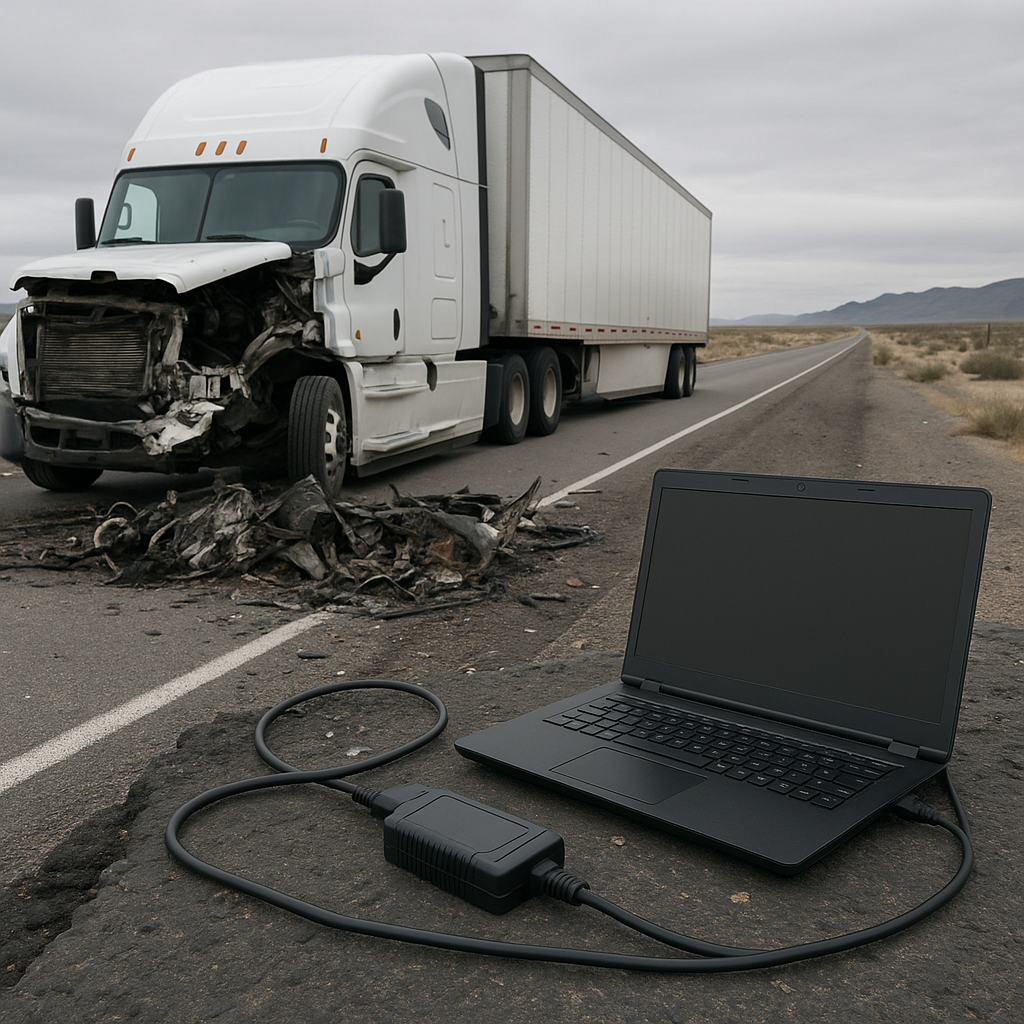
Depending on the complexity of the crash, data collection methods may involve connecting diagnostic scanners directly to a truck’s EDR or recovering memory chips after accidents involving heavy vehicle damage. In many cases, trucking companies may also be contacted, as they might hold telematics or extended EDR data that complement onboard records.
Documentation Typically Involved
The intention behind thorough documentation is to create an unbroken chain of evidence, making it possible to support subsequent findings with concrete data. For black box data collection in Nevada truck accidents, the following documentation is commonly part of the process:
– Initial Accident Report: Offers context and catalogues onsite evidence for follow-up.
– Black Box Data Extraction Forms: Used by law enforcement or technical specialists to log how and when the EDR was accessed, including the technology and software used.
– Chain of Custody Logs: These forms ensure that black box data is securely handled from extraction to analysis, minimizing the risk of data tampering.
– Incident Photographs and Diagrams: Visuals of the accident scene, vehicle positions, and any externally observable damage on the truck that could relate to the data recorded in the EDR.
– Digital Evidence Reports: Details on data sets extracted, as well as metadata about the EDR itself, such as model numbers, data access codes, and retrieval timestamps.
These records are typically compiled into the case file for full transparency and continuity, especially when the findings may be referenced in insurance claims or legal proceedings.
Common Reporting Misunderstandings
Despite the increasingly central role of black box data in truck accident investigations across Nevada, several common misconceptions persist regarding its retrieval and use. One frequent misunderstanding is that the data is universally accessible at any time after an accident. In reality, EDR access often requires specific authorization, proprietary tools, or cooperation with the truck’s manufacturer or data custodian. This ensures the privacy rights of vehicle operators and companies are respected and that the data remains intact throughout the investigation.
Another misconception revolves around the type and scope of data that black boxes can provide. While these devices capture invaluable information—such as vehicle speed, brake application, seatbelt usage, and engine diagnostics—they may not record every desired detail. Not all trucks store the same data types, and the retention period may be limited, with older data overwritten if the vehicle is put back into service. Understanding these technical limitations is crucial for all parties involved.
Additionally, some assume that black box data alone can determine fault or reconstruct an accident with complete certainty. While powerful, this data is typically one component in a broader investigative approach. Witness accounts, physical evidence, and expert review complement the digital record to form a comprehensive picture of the incident.
Neutral Closing Paragraph
The process of collecting black box data after Nevada truck accidents is a collaborative, detail-oriented task involving multiple agencies and layers of documentation. By adhering to established protocols and recognizing the boundaries of what these digital devices can reveal, investigators and insurance professionals strive to achieve an accurate assessment of truck collisions. As trucking technology continues to grow more advanced, the role of black box data in Nevada’s crash investigation landscape will only become more central—underscoring the importance of reliable evidence gathering practices for all involved.