How Fog Affects Reno Area Trucking Accidents
Overview of the Nevada Weather or Road Condition Factor
Northern Nevada, with Reno at its heart, is well-known for its dramatic landscapes and unique climate, blending the Sierra Nevada’s mountainous influence with high desert terrain. While the area’s clear blue skies draw in sightseers and commuters alike, there are periods when dense fog can descend unexpectedly. Such fog is not the everyday drizzly mist; in the Reno area, temperature inversions and high humidity — often after rainfall, snowmelt, or during seasonal shifts — can create patches of thick, persistent fog.
As a result, driving conditions along major hubs like Interstate 80, U.S. Route 395, and smaller rural highways can become treacherous with surprisingly little warning. While all motorists face increased risks during low visibility events, commercial truck drivers in particular must quickly adapt to the sudden onset of challenging conditions. Understanding how fog affects Reno trucking accidents is vital for everyone sharing the road and for those interested in Nevada’s highway safety landscape.
How This Condition Affects Trucks Differently Than Cars
Passenger vehicles and commercial trucks exist in two very different realities when visibility drops and drivable distance shrinks. For trucks — particularly the long-haul 18-wheelers and semis traversing northern Nevada — dense fog brings a collection of hazards that distinguish their experience from that of smaller vehicles.
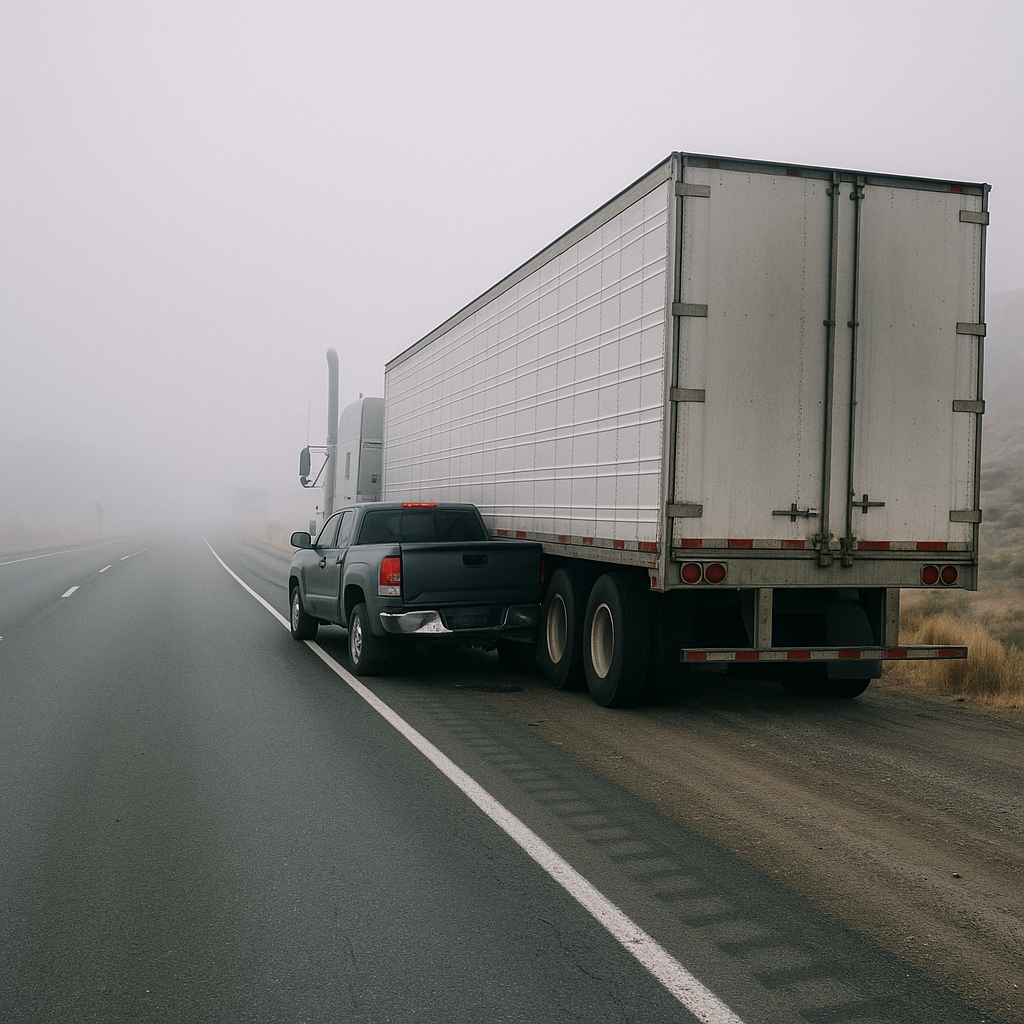
First, trucks have a much longer stopping distance. Tractor-trailers can weigh up to 80,000 pounds when fully loaded; in prime conditions, it takes hundreds of feet to come to a full stop. Fog typically forms suddenly, often catching drivers by surprise and reducing a person’s ability to see taillights, obstacles, or even curves in the road until it’s too late to slow down safely. A car may be able to halt or quickly swerve if an object appears out of the mist, but a semi-truck’s massive momentum makes evasive maneuvers far more difficult.
Second, trucks have larger blind spots. Heavy fog limits what drivers can see both ahead and to the sides, causing commercial drivers to rely heavily on mirrors and sensors. When environmental conditions obscure both mirrors and headlights, the risk of missing nearby cars, smaller vehicles, or even other trucks increases.
Lastly, trucks heighten the risk for multi-vehicle incidents. On foggy mornings in the Reno area, convoys of big rigs often trail each other closely, especially along high-traffic routes linked to logistics and warehousing centers. Limited visibility can contribute to chain-reaction accidents — where one truck’s sudden braking or swerve triggers a series of rear-end collisions involving multiple vehicles. Severe pile-ups in foggy sections of Nevada’s highways highlight just how rapidly conditions can worsen for truck drivers compared to those operating smaller vehicles.
Why Crashes Can Become Severe Under These Conditions
The severity of accidents involving trucks in foggy Reno weather can quickly outpace those occurring in clear or even rainy settings. There are several reasons why poor visibility so often leads to serious or catastrophic incidents:
High Speed and Reduced Time to React: Nevada highways, especially in the Reno area, are designed for faster travel. When fog conditions develop quickly, vehicles may already be traveling at speeds where sudden braking is dangerous — especially with so little time or distance to respond.
Traffic Density and Road Layout: The mix of local and cross-state commercial travel means Reno’s major arteries can get crowded. Add unpredictable fog to a busy corridor, and the result can be confusion or poor decision-making. Drivers unfamiliar with sudden patches of fog may attempt risky maneuvers, creating hazards for long, heavy trucks that can’t pivot or stop on a dime.
Cargo Shifts and Load Instability: Semi-trucks carrying heavy loads — from Reno’s manufacturing, warehousing, or agricultural sectors — are particularly prone to jackknifing or rollovers when sudden low visibility forces quick lane changes or emergency braking. The momentum from a shifting load amplifies the risk of losing control.
Chain Reaction Pileups: In conditions where it’s hard to see brake lights until the last moment, one collision can quickly cascade into several. With trucks, their weight and height present dangers not just to themselves but to all vehicles in the vicinity.
Difficulty in Emergency Response: Dense fog can cause delays in first responder arrival and make it harder for them to see hazards or injured parties on scene. This delay can worsen outcomes following a serious crash on a major Reno-area thoroughfare.
The bottom line: Any crash involving a truck in dense northern Nevada fog is far more likely to result in serious vehicle damage, extended road closures, and increased risk of injury or worse for everyone involved.
Common Seasonal Patterns in Nevada
Understanding when and where fog is likely to appear around Reno can help both truckers and everyday drivers plan for safety. While fog in the Silver State doesn’t occur as often as in some coastal regions, it is a recurring hazard with distinct patterns:
– Autumn and Early Winter: As the region transitions from summer heat to cooler nights, temperature inversions tend to trap cold, moist air at ground level. Dense “radiation fog” often forms during these periods — especially in the Truckee Meadows and valleys near the Truckee River.
– Spring Thaw: Melting snow and rainstorms increase local humidity. This, paired with chilly nighttime lows, can create patchy but severe morning fog, impacting commute and freight schedules.
– After Rain or Overnight Precipitation: Moisture-rich air settling into Reno’s basins after sunset or a storm often leads to overnight fog, lingering into morning hours just as highway traffic ramps up.
– Prolonged High Pressure Periods: Stagnant air locked in by high-pressure systems can increase pollution and moisture, contributing to lower ground fog that impacts area highways and city streets.
Local geography amplifies these events. Low-lying corridors, especially routes running alongside the Truckee River or near Pyramid Way, are particularly susceptible. Truck drivers on longer hauls between Reno, Sacramento, and Salt Lake City frequently encounter these challenging zones — heightening the importance of up-to-date weather and traffic reports.
Neutral Closing Paragraph
Fog remains one of Reno’s most challenging and unpredictable driving hazards, particularly for those operating large commercial vehicles. The combination of Nevada’s unique climate, busy transportation routes, and the physical realities of trucking can turn a routine run into a hazardous journey. While improved forecasting and traffic management continue to mitigate some risks, awareness and caution remain the most effective tools for reducing how fog affects Reno trucking accidents. For anyone sharing Nevada’s highways, staying informed and alert during foggy conditions is a key step toward safer travel, no matter the size of your vehicle.