
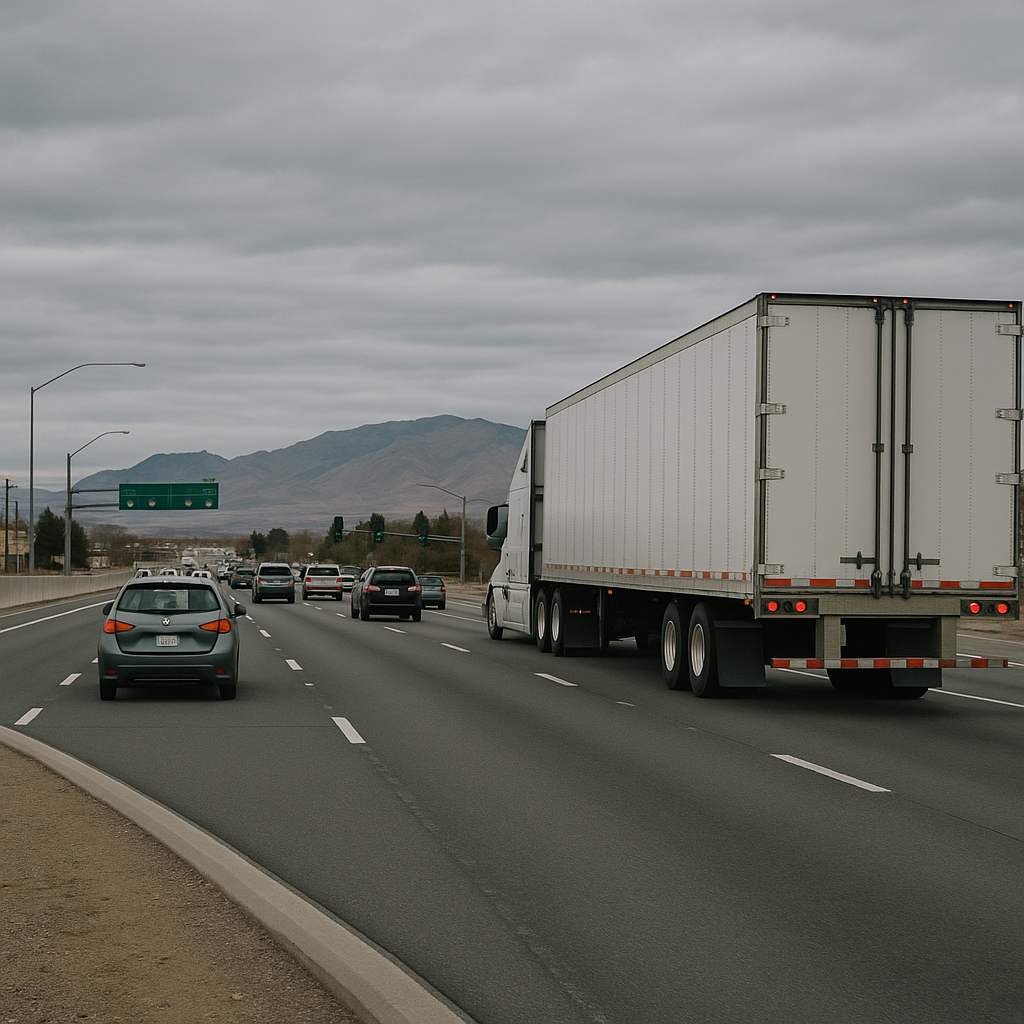
How Nevada Truck Routes Interact with Local Commuter Traffic
Nevada, famous for its sprawling deserts, vibrant cities, and strategic location in the American West, serves as a critical hub for freight traffic. Key Nevada truck routes crisscross major urban centers such as Las Vegas and Reno, cutting through communities on their way to California, Utah, and Arizona. As Nevada’s cities grow and logistics expand, the relationship between heavy-duty trucking and local commuter traffic becomes increasingly important. Understanding how these two streams of traffic intersect is vital for improving safety, efficiency, and the daily experiences of Nevada’s residents.
Overview of the Freight Corridor or Trucking Activity
Nevada’s role as a freight gateway is driven by its geography and the presence of major highways. Key interstates include I-15, running north-south through Las Vegas, and I-80, stretching east-west across northern Nevada, directly linking Salt Lake City and San Francisco. Additionally, routes such as US-95, US-50, and US-93 provide essential connections through central and rural Nevada. These highways don’t just facilitate cross-country freight—they are also lifelines for local economies, supplying goods to Nevada communities and supporting regional industries.
Cities like Reno and Las Vegas sit at the confluence of significant truck routes. The Las Vegas area, for example, sees tremendous truck traffic along I-15, a primary artery for shipments between Southern California and the Intermountain West. Similarly, I-80 through Reno acts as a transcontinental corridor, moving freight between the Pacific Northwest and population centers further east. Between distribution centers, warehouses, and industrial zones—many of which are strategically placed near these major interstates—truck activity pulses at nearly every hour.
As a result, large volumes of truck traffic frequently share road space with local commuters, especially in dense areas, highway interchanges, and sections where freight lanes feed directly into urban streets and neighborhoods.
Common Truck Types and Freight Activity in the Area
Nevada’s highways see a mix of commercial vehicles, each with its own dynamics and impact on shared roadways. The most visible are the Class 8 tractor-trailers—commonly called 18-wheelers—that transport consumer goods, groceries, building materials, and manufacturing supplies. These trucks might be operated by regional carriers delivering to Nevada stores and factories, or by long-haul trucking firms moving freight cross-country.
On top of the standard semis, Nevada also accommodates:
– Double and triple trailers: Common on highways like I-80, especially due to Nevada’s legal framework and infrastructure suited for longer combination vehicles (LCVs).
– Refrigerated trucks (“reefers”): Shipping perishable goods to and from agricultural regions, distribution centers, and grocery stores.
– Hazardous materials trucks: Serving the mining sector—one of Nevada’s economic pillars—by moving chemicals and ores.
– Local delivery trucks: These smaller vehicles manage the “last mile” of logistics, reaching directly into neighborhoods and commercial districts.
Reno and Las Vegas are home to numerous freight terminals and distribution centers. These hub operations result in constant truck movements as goods are sorted, consolidated, and dispatched to retail, hospitality, and industrial locations statewide. This means that truck activity isn’t limited to highways; it frequently pours onto arterial city roads, especially during morning and afternoon delivery windows.
How Congestion or Merging Creates Risk
When Nevada truck routes merge with commuter-heavy roadways, risks and frustrations can arise for all drivers. Congestion is most pronounced in metropolitan areas—Las Vegas’ Spaghetti Bowl interchange (where I-15 and US-95 meet) routinely ranks among the region’s busiest and most complex traffic nodes. Similarly, segments of I-80 near downtown Reno encounter daily rush hour slowdowns as commuters and freight trucks jostle for space.
These congested areas pose several challenges:
– Speed differentials: Trucks require more distance to speed up, slow down, or stop, which can create hazardous situations as trucks and passenger vehicles attempt to enter or exit highways at different speeds.
– Reduced visibility: Large trucks can block sight lines for smaller vehicles, especially in dense merging zones, making it harder for commuters to anticipate lane changes or traffic slowdowns.
– Weaving and lane changes: In highway sections where on-ramps and off-ramps cluster, both truckers and commuters may need to weave, increasing the chance of side-swipes or sudden stops.
– Bottlenecks at interchanges and exits: Areas where freight traffic leaves highways to access local streets—necessitated by proximity to distribution centers or industrial districts—can create unexpected slowdowns for unprepared commuters.
Safety concerns peak at locations where highway segments transition to city streets, especially during delivery rushes or in zones near industrial parks. Because trucking schedules often don’t align perfectly with standard commuter rush hours, there can be surprise congestion spikes when fleet dispatches coincide with school runs or work commutes.
Commuters can experience frustration with slower-moving or turning trucks, while truck drivers struggle with rapid, unpredictable lane changes and short entrance ramps. Both face heightened risks when merging or braking capacity is compromised. This underscores the need for infrastructure planning that considers growth in both freight and local traffic.
Time-of-Day and Seasonal Traffic Trends
Timing has a tremendous impact on Nevada’s truck-commuter interface. Each day, multiple peak periods shape the flow of both freight and passenger vehicles.
Weekday rush hours—typically 7–9 a.m. and 4–6 p.m.—often see the densest mixing of truck and car traffic. In some cases, local ordinances and company policies encourage (or require) trucks to avoid urban delivery or terminal departures during these windows. However, the need to meet tight delivery schedules or coordinate with out-of-state logistics means that heavy trucks often remain part of the rush hour mix, particularly along I-15 in Las Vegas and I-80 through Reno-Sparks.
Midday and late-night hours tend to be favored by long-haul truckers seeking to avoid urban congestion, especially when navigating past distribution hubs or across city boundaries as they head for the open highway. Many deliveries to retail centers and casinos in Las Vegas, for instance, must occur overnight when loading docks are accessible and crowding is minimal. This means that some commuters—such as late-shift workers or early-morning travelers—may still encounter substantial truck flows outside typical “rush” times.
Seasonality matters, too. Nevada’s convention and tourism-driven economy means that Las Vegas and Reno experience unique traffic surges, tied to large events, holidays, or major trade shows. Truck deliveries supporting these events can amplify city congestion, particularly near venue districts and hotel corridors. Seasonal weather also plays a role, especially during winter snowstorms in Washoe and Elko counties or intense summer heat impacting mechanical reliability for trucks and cars alike.
Highway construction or repair—sometimes accelerated during certain seasons—can further concentrate trucks and commuters into narrower lanes or detour routes, making predictable congestion a challenge.
Neutral Closing Paragraph
In Nevada’s evolving urban and rural landscapes, the interaction between truck routes and local commuter traffic reflects the state’s growth as a commercial crossroads. Highway planners, trucking companies, and commuters alike share in the daily negotiation of these shared spaces, adapting to patterns shaped by industry, commerce, and community needs. Efforts to streamline traffic flows and enhance safety continue to shape Nevada’s infrastructure for the future of both freight and local travel. Understanding these dynamics is essential as the Silver State remains a pivotal link between the broader western U.S. and its own thriving communities.