
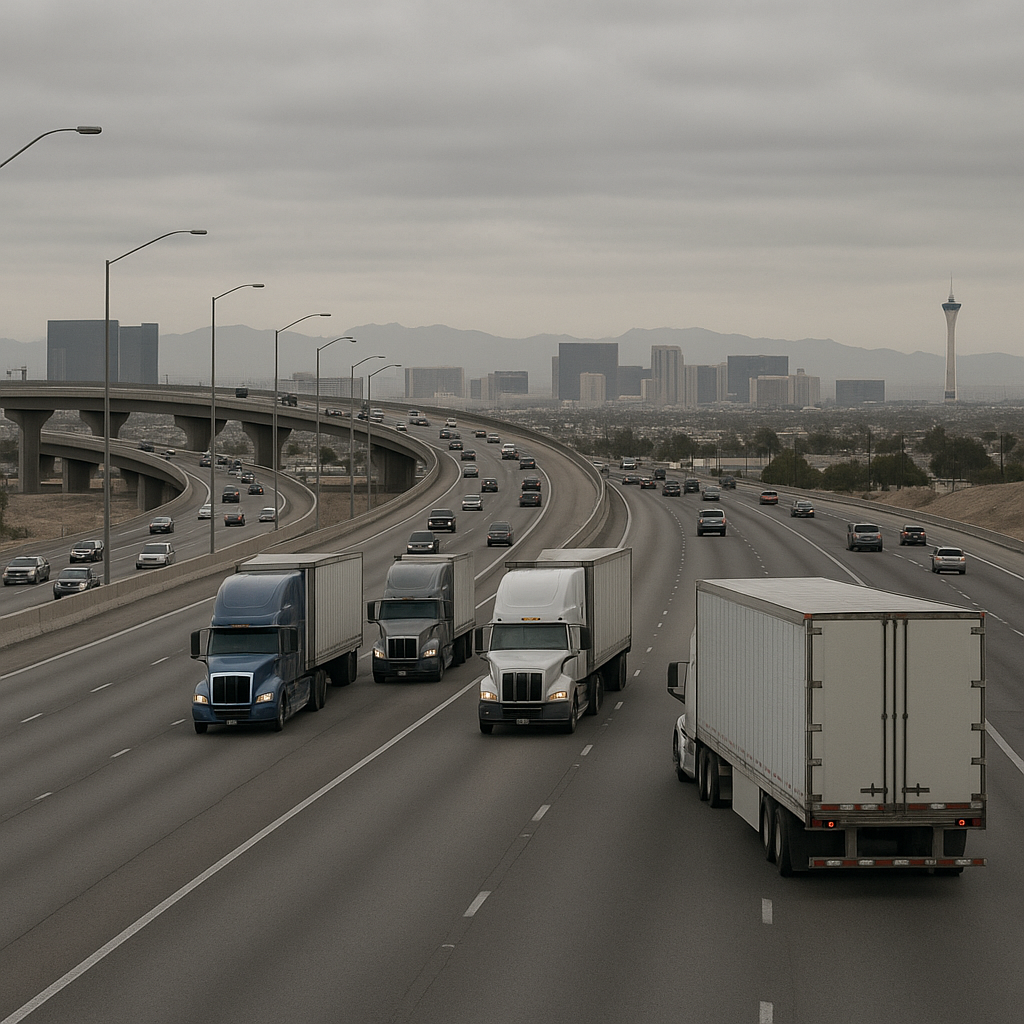
Navigating I-215 Beltway Freight Traffic Around Las Vegas
Overview of the Freight Corridor and Trucking Activity
The I-215 beltway, officially known as the Bruce Woodbury Beltway, is a critical component of the Las Vegas metropolitan area’s transportation infrastructure. It serves as a semi-circular loop, connecting key regions, neighborhoods, and commercial hubs in Clark County. Spanning roughly 50 miles, I-215 links Las Vegas’s rapidly expanding suburbs, the McCarran International Airport (now Harry Reid International Airport), major highways such as I-15 and US 95, and popular destinations.
In recent years, economic growth has fueled significant freight movement around Las Vegas, positioning the I-215 beltway as a principal route for commercial trucking. The beltway supports not only local deliveries but also regional and interstate freight, acting as a bypass for through-truck traffic that seeks to avoid the city center. Distribution centers, warehouses, and manufacturing facilities near Henderson, North Las Vegas, and the southwest valley rely on this route for efficient transportation of goods.
The strategic relevance of the I-215 corridor to Nevada’s logistics sector cannot be overstated. As e-commerce and trade with neighboring California and Arizona surge, the volume of trucks traversing the beltway rises accordingly. This makes understanding I-215 beltway freight traffic in Las Vegas vital for businesses, freight operators, and residents alike.
Common Truck Types and Freight Activity in the Area
I-215’s freight traffic includes a diverse array of commercial vehicles:
1. Long-haul Tractor-Trailers
Primarily responsible for the long-distance transport of goods, these 18-wheelers carry consumer products, building materials, machinery, and perishable items either to Las Vegas or passing through toward markets in Arizona, Utah, or California.
2. Box Trucks and Delivery Vans
With the spread of massive e-commerce fulfillment centers, box trucks and delivery vans are a frequent sight, handling last-mile deliveries to retail establishments, homes, and businesses in the Las Vegas metro area.
3. Specialty Freight Vehicles
Certain sections of the I-215 corridor are frequented by tankers (fuel and chemicals), flatbeds (construction materials), and refrigerated trucks (produce and pharmaceuticals), especially when major events or construction projects are underway.
4. Local and Regional Carriers
Smaller trucking companies serving distribution centers to stores, hotels, and casinos regularly use the beltway, taking advantage of interchanges that provide direct access to commercial districts or the Las Vegas Strip.
Noteworthy hubs generating significant truck activity on and around I-215 include:
– The southwest industrial parks near Decatur Boulevard
– The warehouse clusters near Henderson
– Proximity to Harry Reid International Airport for air-freight transfers
This mix of vehicle types underpins the robust logistic framework that supports not just Las Vegas, but supply chains throughout southern Nevada.
How Congestion or Merging Creates Risk
Like many urban beltways, the I-215 corridor presents unique challenges for both truck drivers and passenger vehicles, especially during congestion or at merging points. Several key factors contribute to increased risk along this freight corridor:
High Volume, Limited Lane Space
Despite ongoing expansions, certain stretches of the beltway experience high volatility in traffic density. Trucks require more space and time to maneuver than cars, making sudden slowdowns or lane reductions particularly hazardous.
Complex Interchanges and Merging Traffic
Locations like the Spaghetti Bowl, as well as junctions with I-15 and US 95, result in heavy flows of converging vehicles, including large trucks. These areas are prone to “weaving”— vehicles rapidly merging on and off the beltway—which elevates the risk of side-swipe and rear-end collisions.
Blind Spots and Lane Changes
Tractor-trailers have significant blind spots (“no zones”) on all sides. In congested conditions, passenger vehicles may dart into these blind spots or cut off trucks as lanes merge, increasing the potential for accidents.
Fatigue and Inattention
Long-haul drivers passing through Las Vegas, especially after traversing long desert stretches, may be fatigued or unfamiliar with local merging patterns. Sudden shifts in congestion or construction can catch them off-guard.
Weather Conditions
While Las Vegas is known for its dry climate, sudden rainstorms or dust storms, especially in spring and fall, can drastically reduce visibility and worsen stopping distances for heavy trucks.
Time-of-Day and Seasonal Traffic Trends
Understanding temporal traffic patterns on I-215 is critical for efficient freight operations and safer travel for all road users.
Peak Freight and Commuter Hours
– Morning Rush Hour (6:30 a.m. – 9:00 a.m.): Commuter traffic surges, creating congestion around key beltway interchanges. Local delivery trucks often operate during this window, adding to the mix.
– Midday Lull (10:00 a.m. – 2:30 p.m.): Traffic lightens, allowing long-haul trucks to traverse the beltway more efficiently. Many logistics companies schedule freight movement during this window to avoid peak delays.
– Afternoon/Evening Rush (3:30 p.m. – 7:00 p.m.): Congestion rises again as commuters head home. Trucks making end-of-day warehouse or retail deliveries share the roadway, increasing lane-change activity and merging at bottlenecks.
Seasonal Variations
– Convention and Event Seasons: Major conventions, such as CES in January, draw thousands of out-of-town attendees and significant additional freight, which can increase congestion not just on the Strip, but on the beltway corridors serving major hotels and convention centers.
– Summer Heat: High temperatures impact roadway conditions and truck operations, sometimes necessitating additional stops for engine cooling or tire checks. Road maintenance projects frequently occur during the summer, leading to lane closures or restrictions.
– Holiday Periods: There is often a spike in freight movement in the weeks leading up to holidays, especially for consumer goods and perishables. The winter holiday shopping season, in particular, sees increased activity from delivery services and retailers replenishing inventories.
Strategic Planning
Larger freight companies and logistics providers often use real-time traffic data and advanced GPS-routing to time their runs along I-215, minimizing exposure to the heaviest congestion. Coordination with local warehouse operators also helps optimize delivery schedules.
Neutral Closing Paragraph
The I-215 beltway plays a vital role in supporting Las Vegas’s thriving logistics and freight ecosystem. As the region continues to expand, the careful management of I-215 beltway freight traffic in Las Vegas will remain an ongoing priority for businesses, truck drivers, and residents. Staying informed about local traffic patterns and infrastructure developments can help all road users share the road safely and efficiently while supporting southern Nevada’s economic growth.