
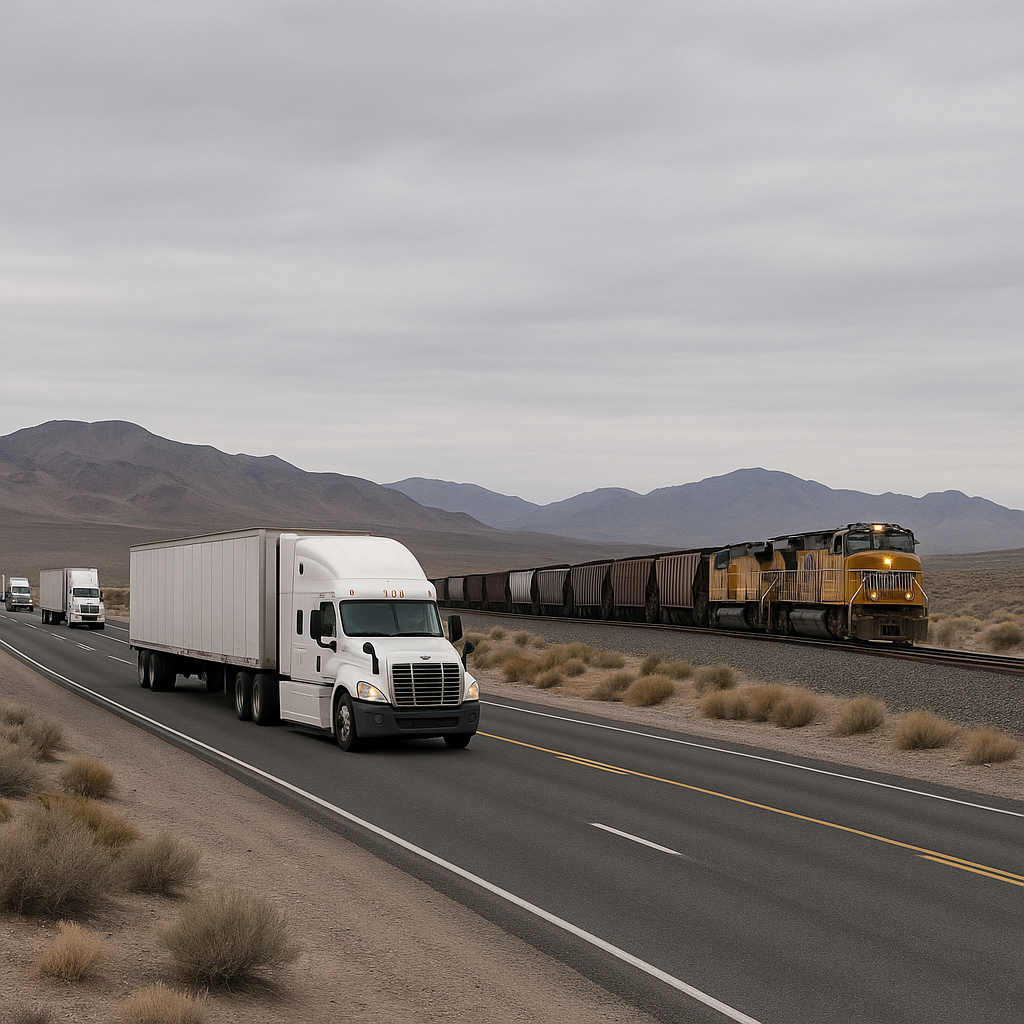
Truck Traffic Near Nevada Rail Corridors: Understanding Patterns, Risks, and Trends
Overview of the Freight Corridor and Trucking Activity
Nevada’s strategic location in the Western United States makes it a vital conduit for freight movement. The state’s sprawling deserts are crisscrossed by major highways and Union Pacific rail lines, creating busy multi-modal corridors where trucks and trains often operate in proximity. These transportation arteries—including the I-80 corridor along Northern Nevada and corridors flanking the Union Pacific mainline near Las Vegas and Reno—form the backbone of regional and national logistics.
“Truck traffic near Nevada rail corridors” is a common sight, especially in urban-industrial zones and at key transfer points such as intermodal yards and logistics parks. Nevada’s growth as a distribution and warehousing hub, fueled by e-commerce and its low-tax business environment, further intensifies this activity. Large warehouses and fulfillment centers in Reno-Sparks, Fernley, and North Las Vegas routinely generate a constant flow of tractor-trailers linking up with nearby railheads for goods movement both east-west and north-south.
Such proximity between trucking and rail operations stems from practical efficiency: goods arriving by train are offloaded and swiftly hauled by truck to their final destinations across the state or region. Yet, as truck and train volumes increase, so do the traffic complexities and safety considerations unique to Nevada’s landscape.
Common Truck Types and Freight Activity in the Area
Truck traffic near Nevada rail corridors is remarkably diverse, reflecting the wide array of industries supported by rail and logistics services. Most commonly, the following types of trucks and freight move in and out of Nevada’s rail corridors:
– Dry van tractor-trailers—the classic 53-foot box trailers—dominate the scene, transporting consumer goods, electronics, apparel, and dry groceries.
– Refrigerated trucks (“reefers”) are frequently seen hauling perishable food through the I-80 and US-95 corridors, linking California agriculture to Nevada, Utah, and beyond.
– Flatbed trucks and lowboys are common for moving machinery, construction materials, and wind or solar energy components—particularly near industrial parks and renewable energy projects along rail lines.
– Tankers move bulk chemicals, fuels, and mining-related inputs and outputs, especially in northern Nevada’s mining districts.
– Intermodal chassis—specialized trailers carrying shipping containers—are especially prevalent near intermodal terminals such as the Reno Sparks Intermodal Yard and Rail City in Las Vegas.
Each of these truck types contributes to steady flows of inbound cargo from regional railheads and outbound shipments destined for markets across the Intermountain West. Given that much of Nevada’s rail freight is containerized or bulk goods, intermodal and tanker loads are a familiar sight near these corridors.
Smaller delivery vehicles, service trucks, and even oversized “pilot escort” vehicles further mix with standard highway rigs. All must navigate the on- and off-ramps, rail crossings, loading docks, and warehouse access roads crowded around these busy corridors.
How Congestion or Merging Creates Risk
Wherever there’s an intersection of high-volume truck traffic and nearby rail operations, the risk for congestion—and with it, safety hazards—increases. In Nevada, this is particularly true at pinch points such as intermodal terminals, rail-adjacent distribution parks, and rail crossings on major state or federal routes.
There are several ways that congestion and merging activity near rail corridors contribute to challenges:
Rail Crossing Backups
At-grade rail crossings near busy freight corridors can force trucks to queue as trains pass. Long waits may entice some drivers to rush through, potentially leading to dangerous “blocking” incidents on the tracks as they attempt to clear before a train arrives.
Tight Spaces and Limited Visibility
Industrial access roads, often built alongside rail lines, are typically narrow with sharp turns or blind spots. Merging trucks, especially those hauling intermodal containers or oversized cargo, may have difficulty gauging oncoming traffic or hazardous conditions—particularly at night or during poor weather.
Complex Lane Changes
On major corridors like I-80 near Reno or I-15 near Las Vegas, trucks entering or exiting industrial parks and rail terminals often must cross several lanes of highway quickly, leading to sudden lane changes or merges. Passenger vehicles weaving through these areas may be unprepared for the slower speeds and wider turns truck rigs require.
High-Density Truck Clusters
At certain hours, surges of truck traffic may overwhelm local infrastructure, leading to bottlenecks at entry and exit points to rail-based logistics centers. Delays cause frustration, sometimes resulting in reckless maneuvers or increased risk of rear-end collisions.
Equipment Malfunctions
Frequent starting, stopping, or idling near rail crossings and logistics hubs can increase the risk of mechanical failure—such as brake overheating or “jackknifing”—especially when road surfaces are sandy, icy, or uneven, as is sometimes the case in Nevada’s high desert.
These issues require careful planning from both infrastructure managers and commercial drivers. Local authorities routinely monitor congestion hot spots and work with state agencies, such as the Nevada Department of Transportation (NDOT), to prioritize safety improvements and optimize traffic flow.
Time-of-Day and Seasonal Traffic Trends
The pattern of truck traffic near Nevada rail corridors is not static; it closely follows logistics schedules, consumer demand, and even the impacts of seasonal weather.
Time-of-Day Patterns
– Morning Rush (5 a.m. – 9 a.m.): Many trucks overnight on the fringes of urban areas and begin early-morning hauls, leading to increased traffic on highways and within industrial parks as businesses open and early freight deliveries commence.
– Midday (10 a.m. – 2 p.m.): Traffic remains steady as loading and unloading continues at intermodal and distribution centers. This window often sees a lull as compared to rush hours, but higher than typical non-corridor routes.
– Afternoon Rush (3 p.m. – 6 p.m.): Another spike occurs as warehouses work to dispatch loads before closing times, with truckers aiming to clear urban areas before evening curfews or congestion.
– Overnight (7 p.m. – 4 a.m.): Many long-haul drivers opt to move at night, taking advantage of lower traffic volumes—but major rail yards often switch crews or handle late arrivals, creating localized congestion even during off-peak periods.
Seasonal Variations
Nevada’s environment, from hot desert valleys to snowy mountain passes, shapes seasonal truck and rail activity:
– Winter months bring snow and ice to the Sierra Nevada and higher elevations along I-80, sometimes closing passes or delaying freight. Rail and truck traffic may bunch up when pass closures are lifted, increasing risks near congested rail corridors.
– Spring and fall coincide with peak agricultural shipments and consumer demand surges, particularly in the lead up to holiday shopping seasons. This results in more intermodal traffic as shipping containers land in Nevada’s rail yards for sorting and interstate transport.
– Summer is marked by extreme heat, which can stress both truck and rail equipment. Scheduled maintenance or heat restrictions on tracks and roads may temporarily slow traffic, causing periodic surges as freight movements resume.
Conclusion
The intersection of truck and rail operations in Nevada’s freight corridors is shaped by geography, industry, and infrastructure. While these corridors are vital to the movement of goods across the state and beyond, they require careful coordination to manage risks posed by congestion, merging, and busy truck-rail interfaces. By understanding the types of freight, timing patterns, and the particular Nevada challenges—be it desert weather, mountain passes, or rapid warehouse growth—businesses and stakeholders can better navigate the complexities of truck traffic near Nevada rail corridors. Ongoing efforts to monitor and address these dynamics are key to ensuring the smooth and safe flow of commerce for years to come.